
We are living in an age where knowledge is abundant but increasingly powerless. Ideas travel faster than experience, awareness expands without transformation, and understanding rarely becomes action. This is the crisis of disembodied knowledge—a condition where thinking is mistaken for living, and knowing is detached from doing. Across education, governance, and everyday life, we have learned to articulate reality without inhabiting it. The result is a growing gap between what we know and how we live. From a Conscious Action Training perspective, the way forward is clear but demanding: knowledge must return to the body, to the present moment, and to action. Because in a world facing urgent challenges, knowledge that does not transform behavior is no longer enough—it is incomplete.
Introduction: The Paradox of Knowing More, Living Less
We are living in the most information-rich era in human history. With a few clicks, one can access philosophy, neuroscience, performance theory, policy frameworks, and spiritual traditions. Knowledge travels faster than experience; ideas circulate more widely than they are lived. Yet, despite this unprecedented access, societies across the globe are marked by rising anxiety, deepening disconnection, ecological neglect, and a quiet but persistent ethical paralysis.
This is not a crisis of ignorance.
It is a crisis of disembodied knowledge.
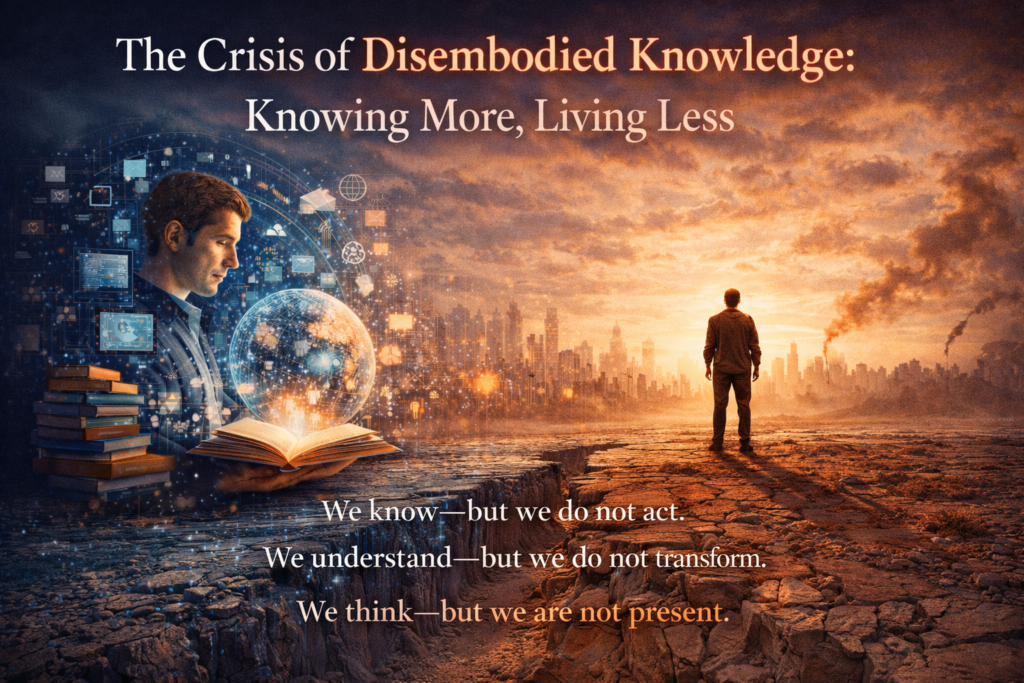
We know—but we do not act.
We understand—but we do not transform.
We think—but we are not present.
From the perspective of Conscious Action Training (CAT), this is not a minor gap in education or awareness. It is a structural failure in how knowledge itself is produced, transmitted, and lived. It reveals a deeper problem: knowledge has been severed from the conditions that make it meaningful—body, action, and lived experience.
What is Disembodied Knowledge?
Disembodied knowledge refers to forms of knowing that remain confined to cognition—abstract, linguistic, and representational—without translating into sensory, relational, and actionable life. It is knowledge that can be articulated but not enacted, expressed but not embodied.
This condition is historically rooted in the epistemological shift associated with René Descartes, who famously separated mind and body, elevating thought as the primary site of truth. “I think, therefore I am” did more than define existence—it redefined knowledge itself. Knowing became an activity of the mind, increasingly detached from the body and from action.
This Cartesian division enabled remarkable scientific and philosophical developments. Yet it also produced a long-term consequence: knowledge became abstracted from lived reality. Thinking was privileged over doing, observation over participation, representation over experience.
In contrast, many traditions across Asia, Africa, and Indigenous cultures have long sustained a different epistemology—one in which knowledge is inseparable from practice, ritual, and embodiment. In these traditions, to know is to enact, to participate, to live. The crisis we face today emerges from the dominance of the former model and the marginalization of the latter.
The Symptoms of Disembodied Knowledge
The effects of this disconnection are visible across multiple domains of contemporary life. One of the clearest manifestations is the persistent gap between knowledge and action. Climate change provides a striking example. Scientific consensus is overwhelming, policy frameworks are well-articulated, and public awareness is widespread. Yet meaningful behavioral transformation remains limited. The issue here is not informational deficiency but experiential distance. The knowledge exists, but it does not move through daily life as embodied urgency.
A similar pattern appears in the emotional and psychological landscape of modern individuals. People are increasingly over-informed but under-experienced, digitally connected yet socially isolated, mentally active yet physically disengaged. Even therapeutic cultures, which aim to address these issues, often remain confined to discourse—talking about emotions rather than transforming the ways in which they are lived and regulated through the body.
In the digital public sphere, awareness itself has become performative. Individuals signal alignment with causes, articulate progressive positions, and participate in discourses of justice, sustainability, and well-being. Yet these expressions frequently remain at the level of representation. They do not consistently translate into sustained, embodied practice. What emerges is a form of engagement that CAT would identify as cognitive performance without conscious action.
Educational systems further reinforce this condition. Across the world, institutions prioritize memorization, conceptual clarity, and examination performance. Students are trained to analyze, interpret, and articulate complex ideas. However, they are rarely trained in attention, presence, ethical responsiveness, or relational awareness. As a result, they graduate with knowledge that is intellectually sophisticated but experientially thin—knowledge that informs but does not transform.
Theoretical Foundations: Beyond the Mind–Body Split
The limitations of disembodied knowledge have not gone unnoticed. Across disciplines, scholars have sought to reconfigure the relationship between knowing, being, and acting. In cognitive science, Francisco Varela and his collaborators introduced the framework of embodied and enactive cognition. From this perspective, cognition is not a process confined to the brain but an emergent property of the dynamic interaction between organism and environment. Knowing is not something we possess; it is something we enact. It unfolds through movement, perception, and engagement with the world. Sociological perspectives, particularly those of Pierre Bourdieu, further illuminate how knowledge becomes embedded in bodily dispositions. Through the concept of habitus, Bourdieu demonstrates that what we know is expressed not primarily through what we say but through how we move, respond, and relate. Knowledge lives in practice, often beneath the level of conscious articulation.
In performance studies, Richard Schechner offers a complementary insight by framing behavior as “restored behavior”—patterns that are rehearsed, repeated, and embodied in social life. Identity itself, from this perspective, is not a fixed cognitive construct but an ongoing performance shaped through action. Educational theory provides perhaps the most direct critique. Paulo Freire challenges the “banking model” of education, where knowledge is deposited into passive learners. He proposes instead the concept of praxis—a continuous interplay of reflection and action. Without action, reflection remains incomplete; without reflection, action lacks direction. Together, these perspectives converge on a single insight: knowledge cannot be separated from the processes through which it is enacted.
CAT Perspective: Knowledge as Conscious Action
Conscious Action Training intervenes at precisely this point of disjunction. It does not reject knowledge, nor does it diminish the importance of thought. Instead, it redefines completion. Knowledge, within CAT, is not complete until it becomes conscious action. This shift begins with the recognition of the present moment as the only site where action can occur. Much of human thinking is oriented toward the past or the future—reflecting, anticipating, planning. While such thinking occurs in the present, its content often displaces attention from immediate experience. This displacement weakens the link between knowing and doing.
CAT reorients attention toward the immediacy of “now,” where knowledge can be enacted rather than merely contemplated. Action, in this sense, is not impulsive but attentive, grounded, and responsive. Central to this process is the revaluation of the body. The body is not treated as an instrument that executes pre-formed ideas; it is recognized as a site of intelligence. Movement, gesture, breath, and rhythm are not secondary expressions of knowledge—they are modes through which knowledge emerges. Awareness is not something that precedes action; it develops through action.
Equally important is the integration of thought, emotion, and action. Disembodied knowledge fragments these dimensions, producing thought without feeling, feeling without action, and action without awareness. CAT seeks alignment, cultivating a mode of being in which thinking, feeling, and acting are mutually informing processes.
Embodiment in Practice
The transformation from disembodied to embodied knowledge is not abstract; it is deeply practical. In applied theatre practices inspired by Augusto Boal, participants do not merely discuss social issues—they enact them. They step into situations, intervene physically, and experience the consequences of their actions. Knowledge here is generated through participation, not transmitted as information. In medical education, simulation-based training has become increasingly central.
Students engage in real-time scenarios that require not only technical skill but emotional regulation, ethical judgment, and situational awareness. Competence emerges through doing, not through theoretical instruction alone. Similarly, contemplative practices, when understood in their depth, emphasize embodiment. Breath, posture, and sensory awareness anchor attention in the body, transforming awareness from an abstract concept into a lived experience. Across these examples, a common principle emerges: knowledge becomes transformative only when it is enacted.
The Political and Cultural Stakes
The crisis of disembodied knowledge extends beyond individual experience into the realms of culture and governance. It enables policy without empathy, leadership without accountability, and development without sustainability. Systems are designed with intellectual sophistication but often fail at the level of lived implementation. There is a growing recognition, particularly within emerging well-being frameworks, that data alone cannot transform societies. Behavioral change is essential, and behavioral change requires embodied practice.
This is where CAT assumes political significance. It offers a framework for training leaders not only to think policy but to embody it, for cultivating citizens who do not merely advocate awareness but practice it. It shifts the focus from informational governance to experiential transformation.
Toward a New Epistemology
Addressing the crisis of disembodied knowledge requires more than incremental reform. It demands a reconfiguration of how knowledge itself is understood. The shift is not from ignorance to information but from abstraction to embodiment, from representation to participation, from awareness to conscious action. This does not diminish the value of knowledge; it deepens it. It situates knowledge within the processes that give it life—attention, action, and relation. It transforms knowledge from a static possession into a dynamic practice.
Conclusion: The Urgency of Embodiment
The future of knowledge systems—across education, governance, art, and community—depends on this shift. The central question is no longer what we know, but how we live what we know. Conscious Action Training offers not only a critique of the present condition but a pathway forward. It calls for a mode of engagement in which thinking becomes grounded, action becomes aware, and knowledge becomes alive.
Until knowledge moves through the body, it remains incomplete. Until it becomes action, it remains inert. And in a world defined by urgent and complex challenges, inert knowledge is no longer enough.
References:
Varela, F., Thompson, E., & Rosch, E. (1991).
The Embodied MindBourdieu, P. (1977).
Outline of a Theory of PracticeFreire, P. (1970).
Pedagogy of the OppressedSchechner, R. (2002).
Performance Studies: An IntroductionBoal, A. (1979).
Theatre of the OppressedDescartes, R. (1641).
Meditations on First Philosophy
సాయి ఆచార్య ఆలోచనకు, ఆచరణకు మధ్య వ్యత్యాసాన్ని బాగా చెప్పావ్ బ్రదర్… ఇలాంటియోక జ్ఞానం లేకపోవడం పోవడం వల్ల మిస్కమునికేషన్ జరుగుతుంది… బోలెడంత షీట్ నీ మోయాల్సివస్తుంది… ఈ knowldwge ఇంకా ముందుకు సాగి ఈకోతమందికి ఉపయోగ పడాలని ఆశిస్తూ…
Thank you doctor Che Nag for your feedback and support.
Good Research, let us join to unfold unknown unseen aspects of life
Thank you doctor for your valuable suggestions and support.