
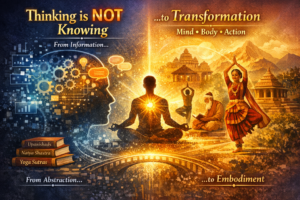
In an age overflowing with information, we have come to mistake thinking for knowing. This article argues that the real crisis of our time is not ignorance, but disembodied knowledge—where ideas remain disconnected from action and lived experience. Drawing from contemporary theories of embodied cognition and resonances with Indian Knowledge System (IKS) and traditions such as the Upanishads, Natya Shastra, and Yoga Sutras of Patanjali, the essay redefines knowing as an integrated process of mind, body, and action. It highlights how true understanding is not what we can explain, but what we can consistently enact, urging a shift from information to transformation, from abstraction to embodiment.
Introduction: The Limits of Thinking Alone
We live in a time when knowledge is increasingly equated with the capacity to think, articulate, and analyze. The ability to explain clearly, argue persuasively, and produce coherent interpretations is often taken as the highest form of intelligence. Educational institutions reward conceptual clarity, professional systems reward analytical speed, and digital culture amplifies those who can produce ideas rapidly and convincingly. Yet beneath this apparent abundance of knowledge lies a growing unease—an unspoken recognition that something essential has been lost.
We are, paradoxically, more informed and less transformed. We can speak eloquently about well-being while living in states of stress and fragmentation. We can construct ethical arguments while struggling to act with integrity in complex situations. We can analyze attention and awareness while remaining deeply distracted in everyday life. This contradiction is not incidental; it points to a deeper structural issue in how knowledge itself is understood. The crisis we face is not a lack of knowledge. It is a crisis of disembodied knowing—a condition in which thought is severed from action, and understanding is detached from lived experience. The problem is not that we think too little. It is that we have come to believe that thinking alone constitutes knowing.
The Historical Construction of Knowledge as Mental Activity
The modern conception of knowledge did not emerge in a vacuum. It is deeply rooted in a philosophical lineage that gradually elevated the mind as the primary site of truth. From early rationalist traditions to Enlightenment thought, knowledge became increasingly associated with cognition—reason, logic, and abstraction. While this shift enabled remarkable advancements in science, technology, and critical inquiry, it also produced a subtle but powerful separation between mind and body.
Within this framework, the body was relegated to a secondary status—an instrument to be controlled, disciplined, or even transcended. Knowing became an internal, mental operation: to process, categorize, represent, and communicate. Education systems inherited this orientation, privileging listening over doing, theory over practice, and articulation over embodiment.
Philosophers such as René Descartes crystallized this divide through mind–body dualism, famously asserting the primacy of thinking as the basis of existence. While subsequent traditions challenged this separation, its influence remains deeply embedded in modern epistemology. The result is a model of knowledge that is highly effective at generating explanations but often limited in producing transformation. It enables us to understand systems, but not necessarily to inhabit them. It allows us to describe reality, but not always to engage with it coherently.
Embodied Cognition: Reclaiming the Whole Human System
In recent decades, a growing body of interdisciplinary research has begun to challenge this disembodied model of knowledge. Fields such as cognitive science, phenomenology, and neuroscience have converged around the idea that cognition is not confined to the brain but distributed across the entire body and its interaction with the environment. Thinkers like Maurice Merleau-Ponty argued that perception itself is inherently embodied—that we do not simply have bodies but are our bodies in the act of knowing. More contemporary scholars, such as Francisco Varela and George Lakoff, have demonstrated how concepts, language, and reasoning are grounded in sensory and motor experiences.
This perspective, often referred to as embodied cognition, suggests that knowing is not an abstract mental process but an activity that emerges from the dynamic interplay of the brain, body, and world. It aligns with what Michael Polanyi described as “tacit knowledge”—the idea that we know more than we can explicitly articulate. Everyday experience confirms this. A dancer navigating complex choreography does not rely on verbal reasoning; their knowledge is enacted through movement. A musician does not calculate each note; they inhabit rhythm and timing. A surgeon develops precision not through conceptual understanding alone but through repeated, embodied engagement with practice. In such contexts, knowledge is not something one possesses as information. It is something one becomes capable of doing. It is enacted, refined, and stabilized through experience.
The Persistent Gap Between Explanation and Execution
Despite this growing recognition, most contemporary systems of education and professional training continue to prioritize conceptual knowledge over embodied capability. This creates a persistent and often frustrating gap between what individuals know and what they can do. We encounter this gap in countless situations. Individuals understand the importance of emotional regulation yet struggle to remain composed under pressure. They recognize the value of attention yet find it difficult to sustain focus. They can explain ethical principles yet falter in moments that require ethical clarity.
This discrepancy is often misinterpreted as a lack of discipline or willpower. In reality, it reflects a deeper misalignment between cognitive understanding and embodied readiness. Knowing at the level of thought does not automatically translate into knowing at the level of action. What is missing is integration—the process through which knowledge becomes embedded in perception, behavior, and response. Integration requires repetition, feedback, and lived engagement. It cannot be achieved through explanation alone.
Performance and Practice: Knowledge in Action
It is within the domain of performance that the limitations of disembodied knowledge become most visible—and where an alternative model emerges with clarity. Performance, whether in theatre, music, dance, or martial arts, is not merely an expression of knowledge. It is a site of knowing. In performance, understanding must manifest in real time. There is no separation between theory and application; the two are inseparable. A performer cannot rely on conceptual explanation in the moment of action. They must draw upon a form of knowing that is immediate, responsive, and embodied. This knowing is cultivated through sustained practice—through cycles of repetition, correction, and refinement.
The importance of practice has been emphasized across traditions. The philosopher Aristotle famously noted that excellence is not an act but a habit, formed through repeated action. Similarly, contemporary expertise research highlights the role of deliberate practice in the development of high-level skill. In performance disciplines, practice is not about mechanical repetition. It is about transforming knowledge into capability—about aligning perception, intention, and action until they function as a coherent whole.
A Resonance with Indian Knowledge System (IKS) and Traditions
Long before modern theories of embodied cognition emerged, Indian Knowledge System IKS and traditions articulated a deeply integrated understanding of knowing. In texts such as the Upanishads, knowledge (jnana) is not defined as intellectual agreement but as realization—a shift in the very structure of perception and being. The Natya Shastra presents performance as a disciplined exploration of human experience, where knowledge is generated and communicated through embodied expression. The Yoga Sutras of Patanjali outlines a systematic path in which insight arises through sustained practice (abhyāsa) and detachment (vairāgya), emphasizing the transformation of consciousness rather than the accumulation of concepts.
These traditions do not treat the body as secondary to knowledge. They recognize it as integral to the process of knowing. Thought, action, and being are understood as interconnected dimensions of a single reality. For a global audience, this offers not a nostalgic return to tradition, but a valuable framework for rethinking contemporary challenges. It suggests that the separation between thinking and doing is neither inevitable nor universal—it is a specific historical development that can be reconsidered.
Conclusion: Toward an Integrated Model of Knowing
The crisis of disembodied knowledge invites us to reconsider one of the most fundamental assumptions of modern life: what it means to know. If knowledge remains confined to the realm of thought, it will continue to produce fragmentation—between understanding and action, intention and behavior, clarity and execution. What is required is not the rejection of thinking, but its integration with the full spectrum of human experience. Knowledge must be cultivated through practice, verified in lived contexts, and stabilized within the body.
This shift has implications that extend beyond education. It affects how we train professionals, how we design institutions, and how we understand human development itself. It calls for a reorientation from information to transformation, from abstraction to embodiment. The question, then, is no longer simply what we know. It is how knowing takes shape within us—how it moves from concept to capability, from thought to action, from idea to lived reality. To pursue this question further, we must turn toward knowledge systems that have long recognized this integration—systems in which knowing has always been a matter of being.
Core Philosophical & Epistemological References
- Gilbert Ryle (1949) The Concept of Mind. University of Chicago Press.
- Michael Polanyi (1966) The Tacit Dimension. University of Chicago Press.
- Maurice Merleau-Ponty (1962) Phenomenology of Perception. Routledge.
- Francisco Varela, Evan Thompson, & Eleanor Rosch (1991) The Embodied Mind: Cognitive Science and Human Experience. MIT Press.
- George Lakoff & Mark Johnson (1999) Philosophy in the Flesh: The Embodied Mind and Its Challenge to Western Thought. Basic Books.
- Noë, A. (2004) Action in Perception. MIT Press.
- Aristotle Nicomachean Ethics.
- Donald Schön (1983) The Reflective Practitioner. Basic Books.
- Richard Schechner (2002) Performance Studies: An Introduction. Routledge.
- Jerzy Grotowski (1968) Towards a Poor Theatre.
- Upanishads (various translations, e.g., Radhakrishnan, 1953)
- Bhagavad Gita. Integration of knowledge, action, and discipline.
- Natya Shastra (attributed to Bharata Muni). Performance as structured knowledge system.
- Yoga Sutras of Patanjali. Knowledge through disciplined practice (abhyāsa).
- Adi Shankaracharya. Knowledge as direct realization, not conceptual belief.
- Damasio, A. (1994) Descartes’ Error: Emotion, Reason, and the Human Brain.
- Ingold, T. (2011) Being Alive: Essays on Movement, Knowledge and Description.
- René Descartes (1641/1996) Meditations on First Philosophy. Cambridge University Press.