
This article explains that in today’s world we are surrounded by more information than ever before, but what is actually becoming rare is our ability to pay attention. While earlier civilizations depended on land, labor, or knowledge, the modern world depends more and more on attention because everything from education to social media is competing to capture it. Attention is not just about focusing; it shapes what we notice, learn, value, and ultimately how we live our lives. When attention is fragmented, learning, decision-making, relationships, and even mental health are affected. In contrast, when attention is strong and conscious, it improves understanding, communication, and action. The article also shows how theatre has always trained attention through presence and awareness, and how this idea connects to Conscious Action Training (CAT), which treats attention as a skill that can be developed. In the end, the article argues that the future will not belong to those who have the most information, but to those who can use their attention wisely, because attention shapes action, action shapes culture, and culture shapes civilization.
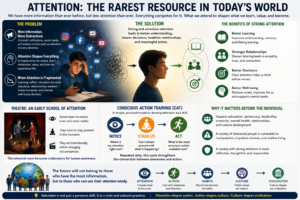
We Are Surrounded by Information, Yet Starved of Attention
We live in a remarkable period of human history. Never before have ordinary people had access to so much information, knowledge, and learning opportunities. With a smartphone in our hands, we can search for answers to almost any question within seconds. We can watch lectures from world-renowned universities, learn new languages through mobile applications, read books from digital libraries, communicate with people living on different continents, and stay updated about events happening anywhere in the world in real time. Information that once required years of travel, research, or access to elite institutions is now available to millions of people at the touch of a screen. In many ways, humanity has achieved what previous generations could only dream of: an unprecedented abundance of knowledge.
Yet, despite this extraordinary access to information, many people feel more mentally exhausted than ever before. Instead of feeling empowered by knowledge, they often feel overwhelmed by the endless flow of messages, notifications, emails, videos, advertisements, and social media updates competing for their awareness every day. Students sit in classrooms with vast educational resources available to them, yet many struggle to concentrate on a lesson for an extended period. Professionals working in offices frequently switch between multiple tasks, emails, and digital platforms, finding it difficult to maintain deep focus on a single piece of work. Even in family settings, where people are physically present together, attention is often divided among various screens and devices. Conversations are interrupted by phone alerts; meals are accompanied by scrolling, and moments of rest are filled with a constant stream of digital stimulation. As a result, many individuals experience a growing sense of distraction, mental fragmentation, anxiety, and fatigue.
This situation reveals an important paradox of modern life. For most of human history, the primary challenge was gaining access to information. Today, the challenge is very different. Information is abundant, but the ability to engage with it meaningfully is becoming increasingly scarce. We are no longer suffering from a shortage of knowledge; we are struggling with a shortage of attention. The real difficulty is not finding information but deciding what deserves our focus and sustaining that focus long enough to understand, reflect, and act upon it. In a world where countless forces compete to capture our awareness every moment of the day, attention has become one of the most precious and limited human capacities. This raises a profound question for our time: if information was the defining resource of the twentieth century, could attention be the defining resource of the twenty-first? The answer to this question may shape the future of education, work, relationships, culture, and even civilization itself.
Every Civilization Depends on a Primary Resource
Throughout human history, every civilization has been built around certain resources that were considered essential for survival, growth, and progress. The story of human development can, in many ways, be understood as a story of how societies identified, controlled, and utilized their most valuable resources. In agricultural civilizations, land and water were the foundations of prosperity. Communities flourished near rivers, fertile plains, and regions where crops could be cultivated successfully. The ability to manage water and agricultural production often determined the strength and stability of entire kingdoms and empires. As history progressed and the Industrial Revolution transformed society, the resources that shaped civilization also changed. Industrial societies depended heavily on labor, coal, oil, steel, machinery, and technological innovation. Economic power was often measured by a nation’s ability to produce goods, operate factories, and mobilize large workforces. Countries that controlled industrial resources gained significant influence and transformed the global order.
During the late twentieth century and the beginning of the twenty-first century, the world entered what is commonly called the Information Age. In this period, knowledge, data, communication networks, and digital technologies became the driving forces of economic and social development. Information was viewed as a valuable asset, and those who could access, generate, and distribute knowledge gained considerable advantages. The internet revolutionized communication, education, business, and everyday life. Information became easier to create, store, and share than at any previous moment in human history. However, this success has produced an unexpected challenge. Unlike earlier periods, where access to information was limited, today’s world is characterized by an overwhelming abundance of information. Every day, billions of messages, videos, articles, advertisements, reports, opinions, and updates are produced and circulated across digital platforms. The problem is no longer finding information; the problem is dealing with the enormous quantity of it.
As information has become increasingly abundant, another resource has become increasingly scarce: human attention. While information can be endlessly generated and replicated, the human capacity to focus, think, reflect, and engage meaningfully remains limited. Every person has only a finite amount of mental energy and attentional capacity available each day. We may have access to thousands of articles, videos, and opinions, but we cannot fully attend to all of them. This creates a new reality in which the most valuable resource is no longer information itself but the ability to direct and sustain attention amid constant distraction. Information surrounds us everywhere, but attention remains limited, fragile, and difficult to maintain. This makes attention one of the most precious resources of contemporary life.
This challenge was recognized long before the rise of social media and smartphones. The economist and Nobel Prize winner Herbert A. Simon offered a remarkably insightful observation in the early 1970s when he argued that an abundance of information creates a scarcity of attention. He understood that as societies produce more and more information, individuals face increasing difficulty in deciding what deserves their focus. The more information available, the more competition there is for human attention. As a result, attention becomes divided, stretched, and fragmented across countless demands. What Herbert Simon described decades ago has become one of the defining conditions of contemporary life. Today, governments, educational institutions, businesses, media organizations, and technology companies all compete for the same limited human resource: our attention. His insight reminds us that the greatest challenge of the modern age may not be producing more information but learning how to manage and protect the attention necessary to use information wisely.
The Attention Economy and Why Attention Matters More Than Ever
In today’s world, some of the most powerful organizations are no longer competing only for money, products, or services—they are competing for something far more basic and human: attention. Companies such as Google, Meta, TikTok, Netflix, and YouTube may look very different in what they offer, but they all depend on the same thing: the amount of time and attention people give to their platforms. The more time users spend engaged with content, the more valuable they become in these digital systems. Because of this, highly advanced technologies are now designed with one goal in mind—to attract, hold, and direct human attention for as long as possible. Features like constant notifications, endless scrolling feeds, algorithm-based recommendations, autoplay videos, personalized content suggestions, and targeted advertisements are all carefully built to compete for the limited attention of users. This has created what many scholars now call the “attention economy,” a system where attention itself has become a kind of currency. However, unlike money, attention cannot be increased beyond a certain limit. Every human being has only a fixed amount of conscious attention available in a day, and once it is used, it cannot be fully replenished immediately. This makes attention not just valuable, but also fragile and easily exhausted.
Because of this growing competition for attention, it becomes important to understand what attention actually means in human life. Attention is often mistaken as simple concentration, but in reality it is much deeper and more powerful. Attention decides what we notice in the world around us, what we remember from our experiences, what we learn and understand, what we begin to value, and how we make decisions in daily life. It also influences how we relate to other people and, in a deeper sense, shapes the kind of person we eventually become. The psychologist William James emphasized this idea when he explained that our experience of reality is largely shaped by what we choose to pay attention to. Attention is not just a mental activity; it is the basic way through which we organize and experience reality itself. Whatever, we consistently give attention to begins to grow in importance in our lives. Where our attention goes, our energy naturally follows. Where energy is directed, habits begin to form. And where habits become stable, they slowly shape the direction of our lives. This means that attention is not only a psychological or individual concern; it has much broader significance. It affects how we learn in education, how we behave in society, how we participate in culture, how we respond in politics, and even how civilizations evolve over time.
Education’s Hidden Crisis
Many education systems around the world still function as if the main challenge in learning is simply the lack of information. Because of this assumption, schools and universities continue to expand their curricula, add more subjects, increase the number of textbooks, and design increasingly complex assignment and examination systems. The underlying belief is that if students are given more content and more knowledge, learning will automatically improve. However, in reality, something very different is happening inside classrooms today. Despite having access to more educational resources than ever before, many students are finding it increasingly difficult to stay focused for long periods of time. Their attention is constantly interrupted, and their ability to remain deeply engaged with one idea, one subject, or one activity is weakening.
The real issue is not always a lack of intelligence or ability. In many cases, the deeper challenge is attention. A student who is unable to focus cannot fully absorb what is being taught, no matter how well the content is presented. Learning requires sustained engagement, and without attention, learning becomes shallow and incomplete. Similarly, a learner who is continuously distracted by external or internal interruptions cannot develop a deep understanding of the subject matter. Even when information is available in abundance, it does not automatically turn into knowledge or wisdom if the learner’s attention is fragmented. In such a situation, education risks producing students who are rich in information but poor in attention, meaning they may know many facts but struggle to understand them deeply or apply them meaningfully in real life.
Because of this growing challenge, many contemporary educational thinkers are beginning to reconsider what education should truly focus on. They argue that cultivating attention may be just as important—if not more important—than simply transmitting information. In this view, attention becomes the foundation of all meaningful learning. Without attention, knowledge remains external and surface-level, something that is quickly forgotten or only partially understood. However, when attention is present, knowledge becomes deeper understanding. It transforms from something that is merely received into something that is truly experienced, processed, and integrated into a learner’s thinking and life.
Democracy Requires Attention
The strength and health of democratic societies depend deeply on the quality of public attention. In today’s world, public conversations about important issues increasingly take place through short videos, quick posts, instant reactions, emotional headlines, and highly simplified narratives. Instead of long, thoughtful discussions, complex social, political, and environmental problems are often reduced to slogans or brief statements that are easy to share but difficult to fully understand. In this environment, careful thinking and subtle differences in opinion struggle to survive, because the system rewards speed, emotion, and simplicity over depth and reflection.
At the same time, citizens in a democracy are expected to make informed decisions about issues that affect their lives and society as a whole. These decisions require more than just exposure to information—they require sustained attention, patience, reflection, and the ability to think critically about different perspectives. However, when attention becomes constantly fragmented by notifications, media overload, and rapid streams of content, it becomes difficult for individuals to hold complex ideas in mind long enough to truly understand them. As a result, public dialogue can become more vulnerable to misunderstanding, emotional manipulation, and simplified narratives that do not reflect the full reality of a situation.
In this sense, attention is not just a personal ability or private skill that individuals use for studying or working. It becomes something much larger and more important—it becomes a shared public resource that supports the functioning of democracy itself. When citizens are able to pay attention deeply and think carefully, democratic dialogue becomes stronger, more thoughtful, and more responsible. But when attention is weakened or scattered, the quality of democratic decision-making is also affected. This is why attention should be understood not only as an individual capacity, but also as a public good that supports the health and future of democratic life.
Mental Health and the Fragmented Self
The modern crisis of attention is not only affecting how people study, work, or make decisions—it is also deeply connected to mental health and overall well-being. Today, many individuals quietly experience a sense of mental overload, emotional exhaustion, and constant distraction in their daily lives. They often feel unable to stay fully present in any moment, as their mind keeps shifting from one thought, task, or notification to another. This creates a feeling of being mentally scattered, where it becomes difficult to experience calmness or inner stability.
The core issue is not only the large amount of information people are exposed to every day, but the continuous breaking and shifting of attention itself. Each time attention is interrupted—whether by a message, a sound, a thought, or a digital alert—the brain has to readjust and refocus. This repeated process of stopping and restarting attention requires mental energy. Over time, this constant adjustment can lead to fatigue, stress, and a reduced ability to think clearly or feel emotionally balanced.
Researchers in psychology and neuroscience have been studying how the ability to sustain attention is closely connected to emotional regulation, learning capacity, resilience, and overall mental well-being. When a person is able to hold attention steadily, their mind tends to feel more organized and calm. However, when attention is constantly broken into fragments, experience itself begins to feel fragmented. Life no longer feels like a continuous, meaningful flow but rather a series of disconnected moments. In such a state, individuals may begin to feel detached not only from their work and responsibilities but also from their relationships, their physical presence, and even their own inner thoughts. This growing sense of disconnection highlights how deeply attention influences not just thinking, but the very experience of being a coherent and grounded human being.
Theatre Has Always Known Something Important About Attention
Long before modern society began discussing attention as a digital or psychological problem, theatre practitioners had already been working deeply with attention through the practice of performance. In theatre, attention is not an abstract idea; it is something that must be lived and practiced in every moment on stage. Theatre demands presence from the performer. An actor cannot truly perform while being mentally absent or distracted, because the nature of performance requires full engagement with the present moment. Actors learn to listen carefully and attentively—not just to words, but to tone, rhythm, silence, and emotional shifts. They also learn an important discipline of performance: to respond to situations as they unfold, rather than reacting impulsively without awareness. This shift from reaction to response is at the heart of theatrical training.
In addition to this, actors are trained to remain continuously aware of many elements at the same time. They must hold attention on their own body, voice, emotional state, fellow performers, stage space, audience presence, and the deeper intention behind the scene—all simultaneously. This creates a highly developed form of distributed yet focused attention. Because of this, the rehearsal room in theatre can be understood as a kind of attention laboratory, where human awareness is trained, refined, and expanded through repeated practice and exploration. In this space, performers gradually realize that effective and meaningful action does not come from mechanical repetition or automatic behavior, but from conscious engagement with each moment as it arises.
This insight is not limited to theatre alone. It carries significance far beyond the stage. The skills developed through performance practice—such as presence, awareness, responsiveness, observation, emotional sensitivity, and intentional action—are increasingly relevant to everyday life in a world filled with distraction and fragmentation. In this sense, theatre offers valuable tools and perspectives for understanding attention more deeply and for learning how to train and strengthen it as a human capacity.
From Attention to Conscious Action
This is the point where Conscious Action Training (CAT) becomes important and meaningful. The CAT begins with a simple but powerful observation about human life today. Most people are not struggling because they lack information or knowledge. In fact, many people already know what is right, what is useful, or what they should be doing in their lives. They may understand their goals, recognize their problems, and even be aware of possible solutions. However, despite this awareness, there is often a clear gap between what they know and what they are able to actually do in a consistent way. Knowing something does not automatically lead to doing it.
The real difficulty lies not in knowledge itself, but in the ability to maintain conscious attention in a stable and directed way. People often lose focus, get distracted, or move away from their intentions due to interruptions, habits, emotions, or external pressures. As a result, their actions do not always match their awareness. CAT suggests that this gap between awareness and action is one of the central challenges of modern human life.
Within this approach, attention is not seen as a fixed quality that a person either has or does not have. Instead, attention is understood as a skill that can be developed and strengthened over time. Like a muscle in the body, it becomes stronger with regular use and practice. Through structured exercises that involve awareness of thoughts and emotions, careful observation of self and environment, embodied experiences through the body, reflective thinking, and intentional action in real situations, individuals can gradually learn how to guide their attention more clearly and effectively.
The aim of the CAT is not only to help people concentrate better for short periods of time. Its deeper purpose is to support conscious participation in life itself. This means being present in one’s actions, making decisions with awareness, and living in a way where attention, thought, and action are more closely connected. In this sense, CAT is not just about improving focus—it is about transforming how a person engages with their everyday life in a more intentional and aware way.
Why Attention May Be the Defining Human Skill of the Future
In today’s rapidly changing world, artificial intelligence and digital technologies are becoming extremely powerful at handling information. Systems powered by AI can process enormous amounts of data in very short periods of time. Machines can store and organize information far more efficiently than human memory. Algorithms can search, retrieve, and present facts almost instantly, making knowledge more accessible than ever before in human history. Because of these developments, many people are beginning to ask an important and deeper question: if machines can already manage information so effectively, what is it that remains truly unique to human beings?
One possible answer lies in the quality of conscious attention. Unlike machines, human beings have the ability not only to receive information but to intentionally direct their awareness toward something, to engage with experiences in a meaningful way, to exercise judgment, and to make choices based on reflection, values, and understanding. Human attention is not just about seeing or hearing; it is about being present, interpreting meaning, and deciding how to respond responsibly in different situations. This capacity to be aware, to reflect, and to act with intention remains a deep human quality that technology cannot fully replace.
As technology continues to grow more advanced and automated systems become more capable of performing intellectual tasks, the importance of human attention is likely to increase rather than decrease. In a world filled with endless information, speed, and automation, the ability to pause, focus, and choose where to place one’s attention becomes even more valuable. The future may not belong simply to those who have access to the most information or the fastest tools. Instead, it may belong to those who are able to use their attention wisely—those who can remain present, think clearly, and act with awareness in the middle of complexity and constant stimulation.
Conclusion: Reclaiming Attention
The central challenge of our time is not only that we are overwhelmed with too much information, but that we are slowly losing the ability to manage our attention in a stable and conscious way. In today’s world, countless forces are constantly competing for human awareness—social media platforms, advertisements, news cycles, entertainment systems, and even everyday digital notifications. Each of these elements is designed to capture and hold our attention for as long as possible. In such a situation, attention is no longer just a simple mental ability used for focusing or thinking; it becomes something much larger and more important. It becomes a resource that shapes how individuals and societies function at a deeper level, almost like a foundation on which modern civilization is built.
The way we educate students, communicate with one another, govern societies, create art and knowledge, perform tasks, and build relationships is increasingly dependent on our ability to pay attention in a conscious and meaningful way. When attention is strong and focused, learning becomes deeper, communication becomes clearer, decisions become wiser, and relationships become more present and human. But when attention is fragmented or constantly distracted, all of these areas begin to weaken. This is why the question facing contemporary society is no longer only about the amount of knowledge we have or the information we can access. It is something more fundamental and urgent.
Instead of asking simply, “What do we know?”, we are now required to ask a deeper question: “What are we actually paying attention to in our daily lives?” Because in the end, attention is what directs our actions. The things we consistently attend to begin to influence our decisions and behavior. Over time, these actions become patterns, and these patterns gradually shape the culture we live in. And when culture takes a stable form, it becomes the foundation of civilization itself. In this way, attention is not just a personal skill—it is the hidden force that quietly shapes the direction of human society.
References
- Herbert A. Simon (1971). Designing Organizations for an Information-Rich World.
- William James (1890). The Principles of Psychology.
- Mihaly Csikszentmihalyi. Flow: The Psychology of Optimal Experience.
- Daniel Kahneman. Attention and Effort.
- Nicholas Carr. The Shallows: What the Internet Is Doing to Our Brains.
- Sherry Turkle. Reclaiming Conversation.
- Jonathan Haidt. The Anxious Generation.
- Richard Schechner. Performance Studies: An Introduction.
- Augusto Boal. Theatre of the Oppressed.