
The essay argues that modern education is failing because it trains students to accumulate knowledge rather than develop the ability to act in real-life situations. While learners become skilled at recalling information, they often struggle with emotional, ethical, and social challenges that require embodied judgment and conscious response. To address this gap, the essay proposes a shift from instruction to “rehearsal,” drawing from theatre practice where learning happens through repeated, reflective action. In this model, education becomes an experiential space where students actively practice life skills such as leadership, empathy, and decision-making, with failure treated as a vital part of learning rather than a deficit. Supported by thinkers like Dewey, Freire, and Goffman, and extended through the CAT (Conscious Action Training) framework, the essay ultimately calls for education to move beyond information transfer toward the cultivation of conscious, responsive human beings who can act effectively and ethically in complex real-world situations.
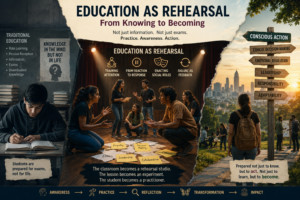
Introduction: There is a fundamental problem at the heart of modern education—and it is not curriculum, infrastructure, or even access. It is far more basic, and far more consequential. Education, as it currently functions, prepares individuals to know—but not to act. Across schools, universities, and training institutions worldwide, students accumulate information, pass examinations, and acquire credentials. They learn to explain, interpret, and analyze. Yet when confronted with real-life situations—ethical dilemmas, emotional conflicts, social responsibility, or leadership challenges—they often falter. For Example: A student may know all the theories of leadership but struggle to lead a team when conflicts arise. The issue is not a lack of intelligence or exposure. It is that they were never trained in doing. They were trained only in knowing. Example: A medical student might memorize symptoms of a disease but freeze when faced with a real patient in distress. This is where the central proposition of this essay emerges—radical in its implication, but unavoidable in its necessity: Education must shift from instruction to rehearsal.
The Problem: Disembodied Knowledge
Modern education rests on an assumption that appears intuitive but is fundamentally flawed—the belief that knowledge naturally translates into action. According to this view, once individuals understand what is right, they will act accordingly. This assumption has not gone unchallenged. John Dewey argued that education must be grounded in lived experience rather than abstract transmission. Example: Instead of just reading about democracy, students should participate in debates or community projects to live democratic values. Paulo Freire went further, critiquing what he termed the “banking model” of education, in which students passively receive and store information without engaging critically or actively with it. Example: A teacher lectures about poverty, and students memorize facts for a test—but they never discuss solutions or engage with communities facing poverty.
Yet despite these influential critiques, the structure of education remains largely unchanged. Students are still evaluated primarily on their ability to recall and reproduce information. As a result, a troubling pattern emerges: individuals can explain ethical principles but fail to act ethically; they can define empathy but struggle to embody it; they can analyze social systems yet feel powerless within them.
This is not a failure of intellect. It is a failure of embodiment. Knowledge, in its current form, remains abstract, dislocated, and non-performative. It exists in the mind but does not enter the body. It does not shape perception, decision, or behavior in real time. In this sense, education produces what may be called disembodied knowledge—knowledge that is known but not lived.
Life Is Not an Exam—It Is a Performance
Human life unfolds not as a series of tests of memory, but as a continuous stream of actions, responses, and interactions. It is, in a structural sense, performative. This insight is articulated with particular clarity by sociologist Erving Goffman, who described everyday social life as a form of performance in which individuals enact roles, manage impressions, and navigate shifting contexts.
If life is inherently performative, then education must prepare individuals not merely to understand roles but to enact them consciously. However, current educational systems do the opposite. They isolate learning from context, delay application indefinitely, and prioritize the evaluation of memory over the cultivation of response.
Students are thus trained for a future moment of application that rarely arrives in the form imagined. When real situations arise, they require immediate, embodied, and context-sensitive responses—capacities that cannot be derived from abstract knowledge alone. The result is a disjunction between preparation and reality. Students are prepared for exams, not for life.
Rehearsal: The Missing Pedagogical Paradigm
In the domain of theatre, rehearsal is indispensable. It is the space where action is explored, repeated, refined, and internalized. Within rehearsal, mistakes are not penalized but utilized; awareness is cultivated through attention; choices are tested and revised; and presence is developed through sustained engagement. No actor is expected to perform without rehearsal. To do so would be considered unprofessional, even irresponsible.
Yet education routinely expects individuals to enter complex domains of life—leadership, relationships, ethical decision-making, collaboration—without any structured rehearsal of these capacities. Graduates are sent into the world to act, decide, and respond without having practiced these actions in a guided and reflective environment.
This is not simply an oversight. It is a fundamental design flaw. To argue that education must become rehearsal is therefore to argue for the restoration of a missing pedagogical space—a space in which action is not assumed, but practiced.
Reimagining Education as Rehearsal
To conceive of education as rehearsal is not to introduce theatre as an additional subject within the curriculum. It is to fundamentally reconfigure the nature of learning itself. In this model, learning becomes an embodied, practice-based, and iterative engagement with reality. At the center of this transformation lies the training of attention. Attention is not merely a passive capacity but an active skill that determines how individuals perceive and respond to the world. Research in contemplative science, particularly the work of Jon Kabat-Zinn, has demonstrated that attention can be cultivated systematically, with significant implications for emotional regulation, decision-making, and well-being. When students learn to observe their thoughts, reactions, and surroundings, they begin to develop the capacity for self-awareness—a prerequisite for conscious action.
This leads to a second shift: the movement from reaction to response. Human beings tend to operate through habitual patterns, reacting automatically to stimuli. Rehearsal introduces a pause within this process—a moment in which alternative responses can be considered and enacted. Through repeated practice, individuals learn not merely to react, but to respond with intention.
Rehearsal also transforms the learning of social roles. Concepts such as leadership, empathy, and citizenship cannot remain theoretical abstractions. They must be enacted within structured environments that simulate real-world complexity. The work of Augusto Boal is particularly instructive in this regard. By converting passive spectators into “spect-actors,” Boal created participatory spaces in which individuals could rehearse social change, experimenting with action before implementing it in lived contexts.
Equally significant is the reconfiguration of failure. In traditional education, failure is associated with deficiency and is often penalized. In rehearsal, failure is integral to the process. It provides feedback, reveals patterns, and opens pathways for refinement. This shift from punishment to iteration fosters resilience, adaptability, and sustained engagement.
The CAT Intervention: From Mechanical Learning to Conscious Action
Conscious Action Training (CAT) offers a structured framework for operationalizing education as rehearsal. It begins with a recognition that is both simple and challenging: much of human behavior is mechanical. Individuals operate through conditioned responses—emotional, social, and psychological—that occur without conscious awareness. An education system that ignores this mechanical dimension cannot produce conscious actors. It may generate informed individuals, but it does not cultivate intentional behavior.
CAT intervenes by introducing practices that disrupt automaticity and cultivate awareness. Through embodied exercises, reflective observation, and iterative performance, individuals begin to recognize their habitual patterns and experiment with alternative modes of action. In this framework, the classroom is transformed into a rehearsal studio, the lesson into an experiment, and the student into a practitioner engaged in the ongoing shaping of the self. This shift redefines the purpose of education. It is no longer concerned solely with the transmission of knowledge but with the cultivation of conscious, responsive, and responsible human beings.
Implications in Practice
When education is restructured as rehearsal, its implications are far-reaching. In school settings, students move beyond learning about values to actively enacting them. Ethical dilemmas are not confined to textbooks but are performed, observed, and reworked. This creates a direct relationship between understanding and action. In higher education, theoretical instruction is complemented by simulation-based engagement. Students encounter complex scenarios, reflect on their decisions, and refine their judgment through repeated practice. Knowledge becomes dynamic and situated, rather than static and abstract.
In the context of governance and leadership, rehearsal introduces a paradigm of preparation that is currently absent. Decision-making, emotional regulation, and public responsibility are practiced in advance, reducing the gap between intention and execution. Leaders trained in this manner are not merely informed; they are prepared.
The Resistance to Rehearsal
Despite its conceptual strength, the transition from instruction to rehearsal is likely to encounter resistance. Rehearsal demands active participation rather than passive reception. It exposes unconscious behavior, which can be uncomfortable for both learners and educators. It resists standardization, making it difficult to assess through conventional metrics. Educational systems, particularly those operating at scale, tend to prioritize control, predictability, and quantifiable outcomes. Rehearsal introduces uncertainty, process-oriented learning, and transformation—dimensions that are not easily measured but are essential for meaningful development.
This resistance is not merely institutional; it is also psychological. To engage in rehearsal is to confront oneself—to recognize patterns, limitations, and possibilities. Such engagement requires a level of openness and commitment that extends beyond conventional learning.
The Civilizational Stakes
The urgency of rethinking education becomes evident when considered within the broader context of contemporary society. We are living in a world characterized by rapid change, increasing complexity, emotional volatility, and pervasive attention fragmentation. Information is abundant, but the capacity to navigate it wisely is unevenly distributed.
In such a context, the value of education cannot lie in the accumulation of information alone. What becomes critical is the capacity to act—to respond effectively under conditions of uncertainty, to regulate emotion, to engage ethically with others, and to adapt to changing circumstances. An education system that fails to cultivate these capacities risks becoming increasingly irrelevant. It may continue to produce degrees, but it will not produce individuals capable of meeting the demands of the present.
Conclusion: From Knowing to Becoming
The proposition that education must become rehearsal represents a fundamental shift in how learning is conceived and enacted. It challenges the assumption that knowledge is sufficient and insists on the necessity of practice, embodiment, and conscious action.
References
- Boud, D., Keogh, R., & Walker, D. (1985). Reflection: Turning Experience into Learning. Kogan Page.
- Dewey, J. (1938). Experience and Education. New York: Macmillan.
- Freire, P. (1970). Pedagogy of the Oppressed. New York: Continuum.
- Kolb, D. A. (1984). Experiential Learning. Englewood Cliffs, NJ: Prentice Hall.
- Goffman, E. (1959). The Presentation of Self in Everyday Life. New York: Anchor.
- Boal, A. (1979). Theatre of the Oppressed. London: Pluto Press.
- Kabat-Zinn, J. (1990). Full Catastrophe Living. New York: Delta.
- Varela, F. J., Thompson, E., & Rosch, E. (1991). The Embodied Mind. Cambridge, MA: MIT Press.
- Mezirow, J. (1991). Transformative Dimensions of Adult Learning. Jossey-Bass.